Share This Article
A practical way to compare BLUETTI power stations, solar kits and backup options before choosing a setup for home, travel or emergencies.
Buying a portable power station is less about choosing the biggest battery and more about matching the equipment to the loads you actually need. A weekend camper, a remote worker and a household preparing for an outage can all need different combinations of capacity, output and recharge options.
We reviewed the Canadian BLUETTI range and pulled out a simple decision path. The aim is to help you compare concrete models, understand what the published specifications mean and know which details to confirm on the store before ordering.
We may earn a commission when you buy through links on this page, at no extra cost to you.
Power needs
Start with the devices you want to run, not the product name. List the essentials and separate short bursts from continuous loads. A phone, router or lamp is a different planning problem from a refrigerator, induction appliance, power tool or RV air conditioner.
Next, decide whether your priority is portability, longer runtime or higher starting power. BLUETTI describes its range across camping, RV, emergency backup and home use, so the Canadian store gives shoppers several ways to size the system. A smaller unit may be easier to move, while a home backup setup needs more capacity and a clearer recharge plan.
Use these questions as your first filter:
- Which appliances or electronics must run?
- What is their running wattage and possible startup draw?
- How long should they operate between charges?
- Will you carry the unit, keep it in an RV or leave it ready at home?
Those answers narrow the field before you compare BLUETTI power station pages. They also prevent a common mistake: treating watt-hours as if they were the same thing as output watts.
Capacity, output and recharge
Capacity, measured in watt-hours, is the size of the energy reserve. Output, measured in watts, is the load the station can deliver at a given moment. A unit can have a useful reserve but still be unsuitable for an appliance whose draw or startup demand exceeds its output rating.
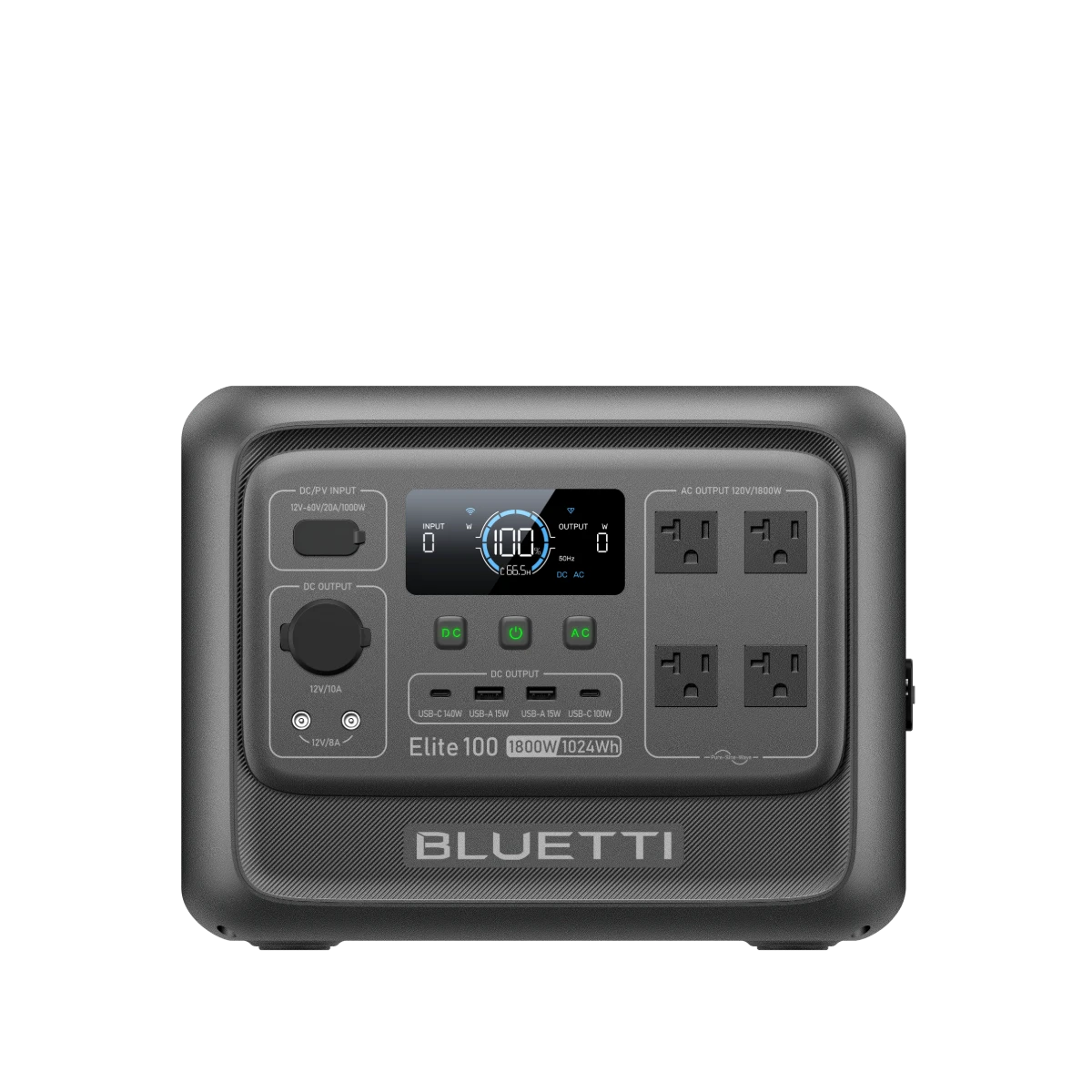
On the store, the linked BLUETTI Elite 100 mini is positioned as a compact option, with the page listing 1,004Wh, 700W and nine ports. That makes it a sensible first page for small electronics, travel and lighter backup needs. The BLUETTI Elite 100 V2 lists 1,024Wh and 1,800W, giving it more headroom for demanding devices while staying in a portable category.
For a larger reserve, the BLUETTI Apex 300 page lists 2,764.8Wh and 3,840W. That specification profile is more relevant to home backup, RV setups and heavier loads than to a quick day trip. Confirm the individual output modes, ports, weight and transfer features on the current page before deciding.
| Option | Published capacity | Published output | Best fit |
|---|---|---|---|
| Elite 100 mini | 1,004Wh | 700W | Compact travel and essentials |
| Elite 100 V2 | 1,024Wh | 1,800W | Portable higher-demand use |
| Apex 300 | 2,764.8Wh | 3,840W | Home, RV and longer backup |
The table is a starting comparison, not a promise of runtime. Actual results vary with the connected load, conversion losses, temperature, battery condition and operating mode. The store is the right place to check current specifications and compatibility.
Solar charging
Solar makes sense when you need more than one charge source or expect to spend time away from reliable mains power. It is especially relevant for camping, RV travel and emergency planning, but the panel size, weather and available daylight affect how quickly a station can recharge.
BLUETTI also lists matched solar-generator combinations. A SORA solar kit can be a simpler route if you want the station and panel considered together. Compare the Elite 100 mini with SORA options, then check cable requirements, folding format, storage and the input limits of the station you choose.

Before adding panels, check four practical details:
- Input compatibility: the panel and station must support the same connection and range.
- Recharge conditions: shade, season and panel position affect real-world collection.
- Storage: panels need a dry, protected place when they are not deployed.
- Use case: a solar kit is more valuable when you expect repeated off-grid use.
If your plan is mainly indoor outage backup, wall charging may be the priority and solar an optional resilience layer. If your plan is remote travel, the balance may reverse. BLUETTI’s solar generator collection is useful for comparing those paths without mixing regions or retailers.
Ownership details
Once the technical fit is clear, compare the details that shape ownership. Weight and handles matter if the station moves between a vehicle and a campsite. Port selection matters if you want to charge several device types at once. For home use, look at transfer behaviour, noise information, expansion compatibility and the manufacturer’s instructions.
Cost also changes with capacity, output, solar panels and accessories. We are not anchoring this guide to a listed amount because store pricing can change. Instead, open the exact product page, compare the current configuration and check what is included before you treat two bundles as equivalent.
For a compact starting point, review the Elite 100 mini details. For more output in a portable form, review the Elite 100 V2 configuration. For a more substantial backup plan, compare the Apex 300 page with the space, wiring and use case you have in mind.
One last look
BLUETTI is a natural choice for shoppers who want a range rather than one fixed format. The Elite 100 mini is the most approachable starting point for compact needs, the Elite 100 V2 adds output headroom, and the Apex 300 makes more sense when backup duration and heavier loads matter.
The honest limitation is that published capacity and output do not predict every real-world runtime. Verify your appliance draw, startup behaviour, recharge method, weight and current configuration on the Canadian product page before ordering.
Choose BLUETTI by the loads you need to run, then match capacity, output and recharge method to that plan.