Share This Article
Autumn camping in Canada asks more of a power setup than a midsummer overnight. There are fewer daylight hours for solar charging, evenings arrive earlier, and a chilly night can change how you plan to use a battery. The right station depends on what you want to keep running, for how long, and whether you can recharge while travelling.
We reviewed the product information on BLUETTI Canada’s store to compare a smaller station, a larger capacity option and a road charging accessory. The aim is a practical match for car camping or an RV stop, rather than a promise that one setup fits every trip.
We may earn a commission when you buy through links on this page, at no extra cost to you.
Autumn’s shorter window
Start with your actual load list, not the largest capacity you can find. A phone, camera and small lights call for a different setup than a cooler, cooking appliance or several devices overnight. Watt-hours estimate stored energy; output watts describe the power a station can deliver to connected equipment. Both matter, and an appliance’s start-up demand can differ from its normal draw.
Shorter days also make a solar-only plan less predictable. A panel may help when the site is open and the weather cooperates, but shade, cloud and campsite orientation all affect generation. Treat solar as an input to plan around, not a guaranteed refill before bedtime. A car-accessible trip gives you another charging option if the vehicle and power station support charging together.
- List the devices you expect to use and their run times.
- Check each device’s running and start-up wattage.
- Allow a margin for cold conditions, cloud and longer evenings.
- Decide whether you need AC outlets, USB charging or both.
Pick your power scale
The BLUETTI Elite 100 V2 sits in the portable middle ground shown on the Canadian product page: 1,024Wh capacity and 1,800W output, with a LiFePO4 battery. That makes it a sensible starting point for a device-heavy weekend or selected small appliances, provided your load calculation fits. Its capacity is not a runtime guarantee; the connected equipment determines runtime.
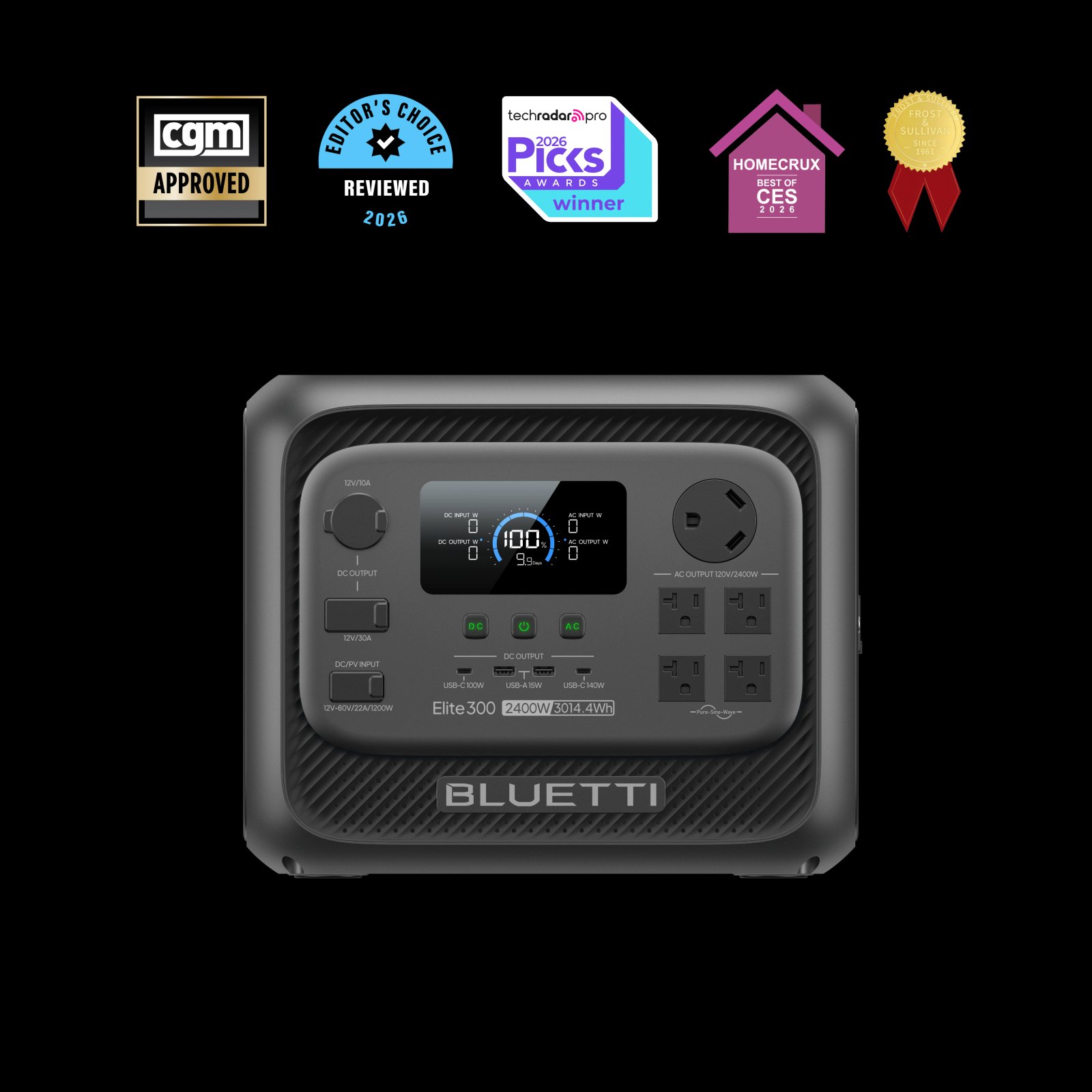
For more capacity and higher output, the BLUETTI Elite 300 is listed at 3,014Wh and 2,400W. Its larger reserve can suit longer stays or a broader set of loads, but it takes more room and weight in a vehicle. If your list is mostly phones and lights, carrying a larger unit may not add enough practical value to justify the space.
Use this quick comparison as a shortlist, then confirm current configuration details on each Canadian product page. Product bundles can differ, and the table is about roles rather than a claim that one model lasts for a fixed number of hours.
| Option | Store-listed detail | Best fit | Trade-off |
|---|---|---|---|
| Elite 100 V2 | 1,024Wh, 1,800W | Modest loads | Less reserve for long stays |
| Elite 300 | 3,014Wh, 2,400W | More devices or longer use | More vehicle space needed |
| Charger 2 | Alternator and solar charging accessory | Road-based recharging | Check compatibility and installation |
Charging between stops
The BLUETTI Charger 2 is presented as an alternator and solar charger for road trips. It can be relevant for driving itineraries and you want to replenish compatible equipment en route. Before choosing it, confirm which station or battery configuration it supports, the required cables and whether installation suits your vehicle.

A portable panel is another possible input when you stop for the day. BLUETTI sells solar charging bundles and panels, but the panel’s rated conditions are not the same as the output you will get in a shaded autumn campsite. Check the station’s accepted solar input and connector requirements before combining components. Keeping the Elite 100 V2 details beside the Charger 2 specifications can help clarify the proposed setup.
Cold-weather planning
Cold temperatures are a reason to read the model’s operating and charging guidance carefully. Battery performance and permitted charging conditions vary by product, so avoid assuming that a station can charge or deliver the same energy in every temperature. Store equipment as directed, keep it protected from moisture, and plan a backup route to power for essential devices.
For a simple plan, separate essential devices from conveniences. Charge phones before leaving service, keep lighting needs modest, and avoid sizing around a heater or cooking appliance until you have checked its demand and the station’s output limits. This is where a larger model such as the Elite 300 may make sense, while a lighter load can point back to the Elite 100 V2.
- Keep the station dry and follow its temperature instructions.
- Do not count on solar output without considering shade and weather.
- Check recharge time and input limits for your chosen source.
- Carry a separate plan for communications and safety essentials.
Ownership details
Before ordering, compare the product page’s included accessories, charging inputs, weight, outlet mix, warranty terms and Canadian delivery details. Bundled panels or batteries can change the setup’s footprint and capabilities, so make sure the item selected is the configuration you intend to use. The Elite 100 V2 listing, Elite 300 listing and Charger 2 listing are the useful place to check those specifics.
The main limitation is that product-page capacity figures cannot predict your campsite runtime on their own. Actual use depends on connected loads, conditions and charging opportunities. For a weekend with a modest device list, start with a smaller capacity; for longer trips or more demanding equipment, compare the larger option and confirm its size fits your vehicle.
One last look
For many car campers, the BLUETTI Elite 100 V2 is the more proportionate place to begin if the load list is modest. Choose the Elite 300 when the extra capacity and output solve a real need, and consider the Charger 2 when compatible road charging belongs in the plan. Check current model details and cold-weather guidance before settling on a configuration.
Match capacity to your real load list, then choose the smallest BLUETTI setup that leaves a sensible margin for colder, darker trips.