Share This Article
Choosing a portable power station is less about finding the biggest number and more about matching output and stored energy to the devices that matter. BLUETTI’s Canadian store spans compact portable units and larger backup systems, so the sensible choice depends on whether the job is occasional device charging, longer outages or a more configurable home setup.
We reviewed the product information for three models with distinct listed capacities and output ratings. The pages make useful comparisons possible, but they do not answer every household question: actual runtime changes with the connected load, and a station’s headline rating is not a promise that every appliance will run for a set duration.
We may earn a commission when you buy through links on this page, at no extra cost to you.
Start with the load
BLUETTI’s range is strongest when its specifications are read as a pair. Output in watts helps indicate which devices can run at once; capacity in watt-hours helps estimate how long stored energy may last. The brand lists the BLUETTI Elite 100 V2 at 1,800W and 1,024Wh, the BLUETTI Elite 300 at 2,400W and 3,014Wh, and the BLUETTI Apex 300 at 3,840W and 2,764.8Wh. These are meaningfully different profiles, not simply small, medium and large versions of the same choice.
- Write down essential loads: note each device and whether it needs to run together with another.
- Separate power from duration: a higher output rating does not automatically mean longer runtime.
- Decide on portability: frequent carrying and a semi-permanent backup setup favour different trade-offs.
That distinction makes the BLUETTI Elite 100 V2 the clearest fit of these three for a relatively contained portable setup. Its lower listed capacity means less reserve for extended use, so it is a weaker match if the brief is to keep several household essentials going for a long outage. For readers who can name a modest set of devices and value a smaller system, its figures are easier to justify than paying for capacity they may rarely use.
The BLUETTI Elite 300 moves substantially higher in both listed capacity and output. That makes it more plausible for longer backup windows or a broader combination of devices, though the larger energy reserve may be unnecessary for someone who only needs to recharge phones and a laptop. Check the product page’s port details and charging guidance against the exact equipment you plan to connect.
Three different roles
The BLUETTI Apex 300 is the interesting outlier: the store lists higher output than the BLUETTI Elite 300, while its listed capacity sits below that model’s. In practical terms, that points toward buyers who need to consider what can run at once as carefully as how long it can be powered. BLUETTI presents the Apex line for home backup, and its product page is the place to confirm configuration and compatibility before planning around it.
- Elite 100 V2: a more contained portable power brief with the lowest capacity here.
- Elite 300: more stored energy for users who value a longer reserve.
- Apex 300: higher listed output and a home-backup orientation, with setup details to verify.
This is where BLUETTI’s breadth helps: buyers can choose a station around a specific use rather than defaulting to one flagship. It is also a limitation. Comparing only model names or one headline number can obscure the difference between output, energy capacity, ports and system expansion. Read the details for the BLUETTI Elite 100 V2, BLUETTI Elite 300 and BLUETTI Apex 300 individually, and treat the named ratings as starting points for a load plan.
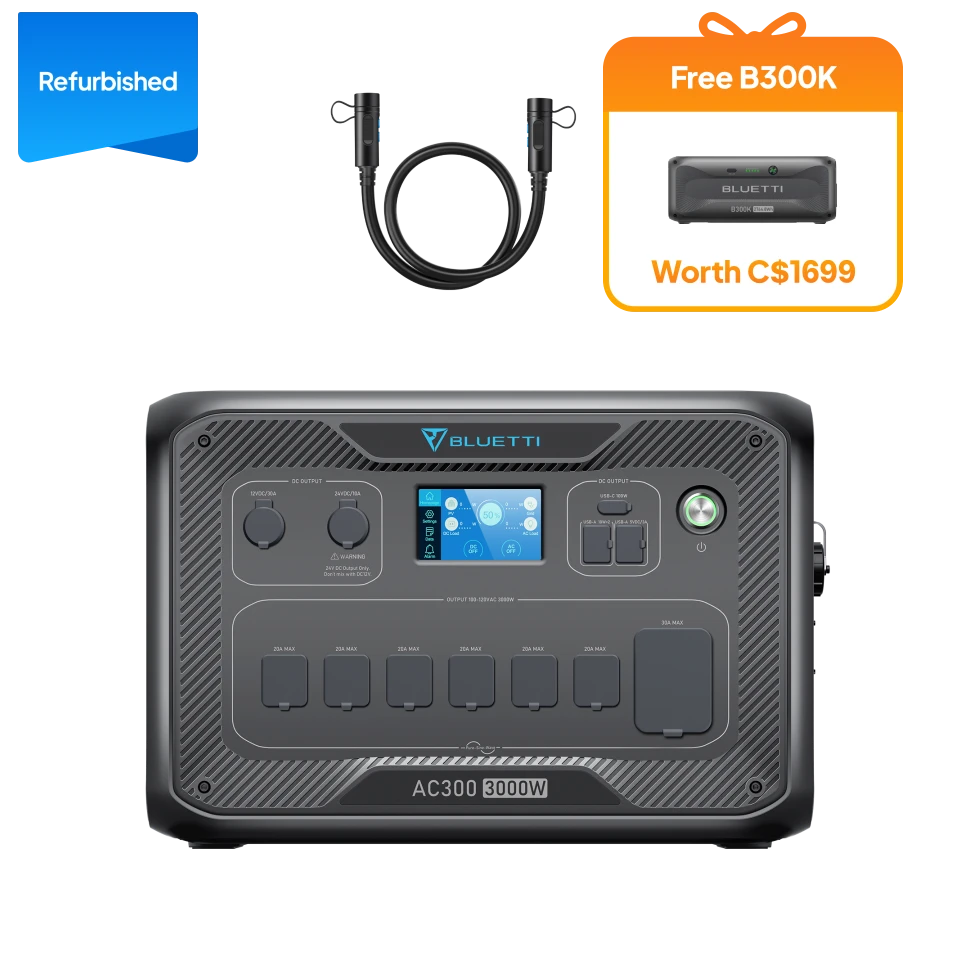
Modularity can be useful, but it adds another compatibility decision. The AC300 and B300K image is an example of a system configuration, not proof that it is the right pairing for every buyer. Check which expansion batteries are supported by the station under consideration and whether the added capacity solves a real need.

Solar is another real strength in the range. The Canadian store lists solar panels and solar-charging bundles, and selected stations support solar input. That can matter for camping or backup where replenishing energy is part of the plan. Yet panel compatibility, charging limits, sunlight and setup all affect the result. A panel pictured beside a station is not enough evidence that every combination works, so confirm the supported input and pairing on the relevant product pages.
Where the range fits
We see the best case for BLUETTI in buyers who can define their loads, value portable or modular power, and are willing to check the technical details before purchase. The range includes LiFePO4 models, app monitoring on selected products, and expansion configurations; those features are model-specific rather than universal promises. The store’s product pages should settle whether a particular unit includes the feature or requires another component.
- Good fit: campers, mobile work setups and households planning a defined backup circuit or device list.
- Less compelling: buyers who need a whole-home solution without planning installation, loads or system compatibility.
- Worth checking: weight, ports, charging methods, battery chemistry, expansion support and warranty terms.
There is also a cost trade-off even without a single number to quote: larger capacity, higher output, solar panels and expansion batteries change the overall system commitment. Start with the essential devices and expected runtime, then compare the BLUETTI Elite 100 V2 for a narrower portable need, the BLUETTI Elite 300 for more capacity, and the BLUETTI Apex 300 when output and home-backup configuration lead the decision. Check current listings for the system components and inclusions that apply in Canada.
One practical caution: product-page ratings alone cannot predict the runtime of a fridge, medical device or other variable load. Battery condition, temperature, conversion losses and device cycling can all change real use. For critical backup planning, verify the equipment’s requirements and plan a margin rather than treating watt-hours as guaranteed usable energy.
One last look
BLUETTI’s Canadian range has a credible spread from portable essentials to more capable backup systems, and its solar and expansion options add useful flexibility. The limitation is the homework: buyers must compare output, capacity, ports and compatible accessories rather than relying on a model’s headline position. For a compact job, begin with the BLUETTI Elite 100 V2; for more reserve, consider the BLUETTI Elite 300; for higher output and a configurable backup direction, assess the BLUETTI Apex 300 closely.
Our recommendation is to shortlist only after listing the loads and runtime you need, then verify every connection and accessory on BLUETTI’s Canada product pages. The numbers offer a helpful filter, but they do not replace a device-by-device plan.
BLUETTI is worth considering when its capacity and output match a defined power plan, with the Elite 100 V2, Elite 300 and Apex 300 serving distinct needs.